| Home - Contact |
|---|
| Español - English |
 |
     |
 |
|---|
 |

|

|
 |
 |
 |
 |
 |
 |
OMTP
OPTICAL MULTISERVICE TRANSMISSION PLATFORM |
|---|---|
Power System protection and control are critical systems required to maintain and guarantee Power System continuity. The associated telecommunication infrastructure has to be designed to fulfil the specific requirements on service availability and reliability |
|
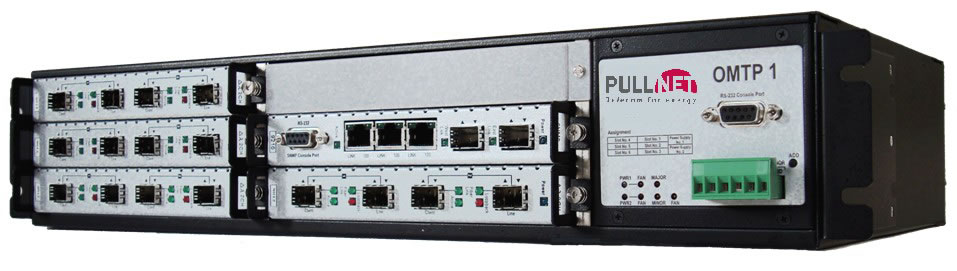
The fulfilment of the communication requirements needed for optimal operation of Protection and Control networks has only been achieved so far by implementing over-dimensioned and complex telecom systems, that involve large investments and elevated maintenance costs. OMTP Series addresses that problem by means of a straightforward and compact solution, whose working principle is based on optical multiplexing technology specifically designed to fulfil the requirements needed in Power Utilities. The compact OMTP system works with up to 8+1 independent bi-directional optical channels per optical fibre pair, in such a way that each of the channels multiplexed over every single link is able to carry anytype of broadband communication. Thanks to this principle, the equipment is capable of providing heterogeneous telecommunication services over a common fibre optic infrastructure. This means that there are no limitations whether in bandwidth — since every chan-nel can work from 64 Kbit/s up to 2.5 Gbit/s —, or in service profile and protocol — since every transmission channel is fully transparent —. OMTP Series includes a wide range of access interfaces, from legacy narrow-band to broadband. An innovative low velocity optical card can also be included to provide service to local devices equipped with optical communications that need the highest levels of reliability and availability |
|
| BENEFITS | |
Robustness. OMTP Series is specifically designed for harsh environments, as those existing in Power Substations. Service availability. The number of different equipments and interfaces needed to implement broadband networks is considerably reduce, in comparison with existing architectures. This important simplification yields in a very high MTBF, or service global availability. Reliability. The use of totally passive multiplexors and the simplification of components result in a design able to fulfil the toughest delay and jitter requirements. Unified management. Advanced management functions based upon IETF/SNMP standards. Integration of legacy systems. Legacy and advanced systems can be merged in a straightforward manner. |
Flexibility. Capability to offer virtually any type of telecommunication service, whether standard or proprietary, via transparent interfaces. Scalability. Compact solution: up to 6 optical cards in a 2 RU rack. Scalable solution: up to 17 cards per 5 RU rack, with the possibility of stacking up to 6 racks. Unified maintenance. Advanced management & maintenance functions that yield to maintenance cost reductions. DWDM compatible. Capability of combining CWDM and DWDM transport over the same fibre optic link. Cost-effective solution. Powerful interfaces without capacity limitations |
 |
|---|
| Datasheet |